
TLDR:Discover how Tactigon Shape Local AI orchestrates offline LLMs via Ollama with minimal client overhead. We measure real-world Block-to-Action Latency across Qwen2.5, Ministral 8B, and Mistral Nemo 12B to help you build responsive block-based workflows.
Benchmark Objective: Evaluating Local LLMs on 40W Edge Hardware #
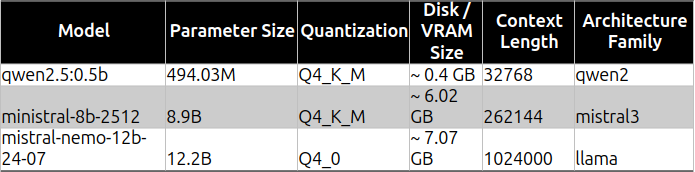
Tactigon Shape is the tool that brings all these moving parts together into a single, repeatable workflow. Specifically, it connects your edge hardware, Ollama, and local LLMs through intuitive visual blocks. As a result, you can test both the hardware and the model effectively under real-world conditions. Let’s see how. In this Tactigon Shape Local AI benchmark, we compare three models of different sizes.
Ultimately, our goal is to measure real Block-to-Action Latency and find the best balance between speed and text quality.
This benchmark evaluates the inference performance, latency, and throughput of local Large Language Models (LLMs) running on an NVIDIA Jetson Orin NX via Ollama.
Ollama gets queried in a local client-server setup by Tactigon Shape.
Test Environment & Hardware Setup (Jetson Orin NX) #
All tests were executed in a controlled local network environment using a dedicated edge inference server and a low-power client host.
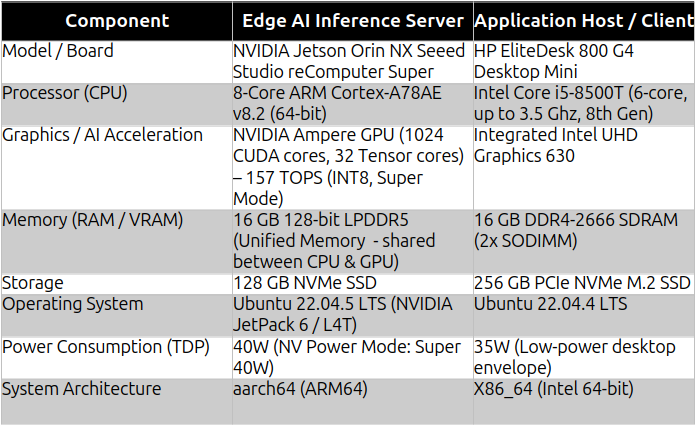
Ollama Docker Configuration & Tested LLM Models #
Client: Tactigon Shape invoking Ollama via local API calls.
Inference Engine: Ollama 0.40.18 deployed via Docker with the following runtime optimizations:
GPU Access: runtime: nvidia, NVIDIA_VISIBLE_DEVICES=all, and NVIDIA_DRIVER_CAPABILITIES=all to expose the Ampere GPU and drivers to the container.
Memory Optimization: OLLAMA_FLASH_ATTENTION=1 and OLLAMA_KV_CACHE_TYPE=q8_0 to halve KV cache memory usage without degrading output quality.
Model Isolation: OLLAMA_MAX_LOADED_MODELS=1 to ensure only one model occupies unified memory per test run.
Benchmarking Methodology in Tactigon Shape #
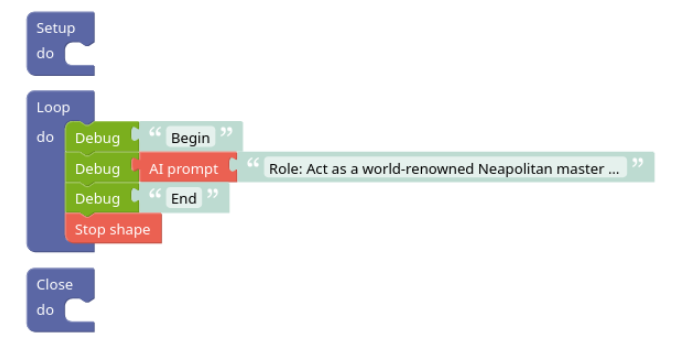
An automated benchmark workflow was built using block-based programming in Tactigon Shape. Each test cycle executes three sequential steps:
Initialization (Debug “Begin”): Logs the starting timestamp immediately before calling the LLM.
Synchronous Inference (Debug AI Prompt): Sends a standardized prompt in blocking mode (no token streaming), waiting for the full response before logging the timestamp and printing the output.
Termination (Debug “End”): Logs the final timestamp once the response is released to the console.
Standardized Prompt and Performance Metrics (TTFT & Throughput) #
"Role: Act as a world-renowned Neapolitan master pizzaiolo with 40 years of experience. You are passionate, direct, and tolerate zero shortcuts. Task: Write a recipe on how to make an authentic pizza. Strict Constraints: 1. Your entire response must be exactly 3 lines long (separated by line breaks). 2. Each line must represent one phase: Dough, Toppings, and Baking. 3. Maintain your passionate Italian chef persona through your word choice, without using clichés like 'Mamma mia'. 4. Negative Constraint: Do NOT include a title, greetings, introductory text, bullet points, or sign-offs. Start immediately with the first line of the recipe."
After the initial warm-up execution (to load the model into unified memory), each model was tested across 2 consecutive warm runs to measure:
– TTFT (Time To First Token)
– Throughput (tokens/s): Token generation speed.
– Output Length & Total Response Time: Total generated tokens and end-to-end execution time (Begin → End).
Benchmark Results: Latency, TTFT, and Token Throughput #
Key Findings: Throughput vs. Output Verbosity #
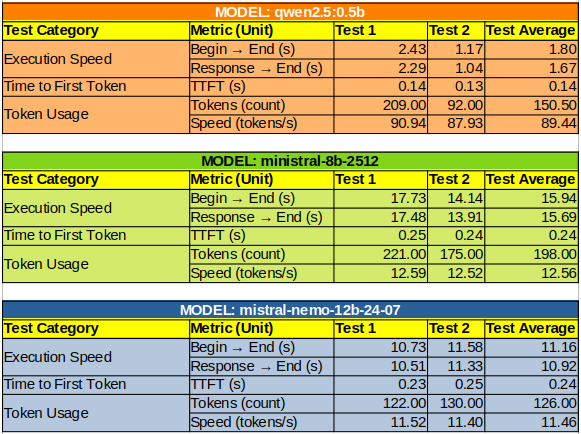
Consistently Low TTFT: Once resident in unified memory, all three models start generating tokens almost immediately (0.14 s for qwen2.5:0.5b and 0.24 s for both 8B and 12B models).
Throughput vs. Verbosity: qwen2.5:0.5b generates tokens roughly 7x faster than the larger models. Meanwhile, ministral-8b-2512 is slightly faster per token than mistral-nemo-12b-24-07 (12.56 vs. 11.46 tokens/s), but generates significantly more verbose responses (198 vs. 126 tokens), making it the slowest overall at 15.94 s.
Impact of Synchronous Execution: Because Tactigon Shape’s AI Prompt block runs without token streaming, the user waits for the entire Begin → End cycle before seeing any output. Total response time—driven by both generation speed and verbosity—is therefore the primary factor in perceived responsiveness.
Conclusion: Choosing the Best Local LLM for Tactigon Shape #
An NVIDIA Jetson Orin NX (16 GB) running a Dockerized Ollama 0.40.18 instance delivers reliable, energy-efficient local LLM inference within a 40W envelope when paired with Tactigon Shape.
Because Shape executes prompts synchronously, model selection should align directly with your latency budget:
Best for real-time, low-latency workflows: qwen2.5:0.5b leads by a wide margin, sustaining 89.44 tokens/s and completing full responses in 1.80 s on average.
Best for complex reasoning and higher text quality: mistral-nemo-12b-24-07 offers the strongest balance on this hardware, completing responses in 11.16 s on average and outperforming ministral-8b-2512 (15.94 s) thanks to more concise outputs.


